- 6 Steps To Move Abroad
- Virtual & Physical Tours
- Relocation Consultation
- Relocation In a Box
- The Nomad Navigator | Total Digital Nomad Relocation
- The Immersion Journey | Student Visa & Language Program
- The Family Odyssey | Family Relocation Package
- The Golden Years Gateway | Total Relocation Package
- The Veteran’s Vantage | Total Relocation Package
- The Legacy Investor | Total Relocation Package
- The Founder’s Launchpad | Short-Term Entrepreneur Visa Package
- The Empire Builder | Total Relocation Package
- Contact Mood

- 6 Steps To Move Abroad
- Virtual & Physical Tours
- Relocation Consultation
- Relocation In a Box
- The Nomad Navigator | Total Digital Nomad Relocation
- The Immersion Journey | Student Visa & Language Program
- The Family Odyssey | Family Relocation Package
- The Golden Years Gateway | Total Relocation Package
- The Veteran’s Vantage | Total Relocation Package
- The Legacy Investor | Total Relocation Package
- The Founder’s Launchpad | Short-Term Entrepreneur Visa Package
- The Empire Builder | Total Relocation Package
- Contact Mood
- MOOD Travel Abroad City Guides:
- Cartagena, Colombia Guide
- Cape Town, South Africa Guide
- Puerto Vallarta, Mexico Guide
- Medellín, Colombia Guide
- Playa Del Carmen, Mexico Guide
- Santa Marta, Colombia Guide
- Panama City, Panama guide
- Hua Hin, Thailand Guide
- Chiang Mai, Thailand Guide
- Bangkok, Thailand Guide
- Thailand Expat Relocation Guide
- Phuket, Thailand Guide
- Pattaya, Thailand Guide
- Koh Samui, Thailand Guide
- MOOD Travel Abroad Resources
- Guide to Visa Types for US Citizens Abroad
- Available Visas for Foreigners in Thailand
- Cultural Adaptation and Integration
- Essential Apps for Your Life Abroad
- Investing Abroad as a Foreigner
- Banking & Finance Resources
- A Realistic Packing List to Move Abroad: The Ultimate Downsizing Checklist
- The 3 V’s: Vision, Visas & Vitals: How to Narrow Down Your Expat Destination
- MOOD Travel Abroad’s Expat Financial Tool Kit: Expat Banking 101
- The Intentional Exploration Checklist: Unlock the Power of Travel to Transform Your Life
- MOOD Travel Abroad’s Universal Visa Document Checklist
- Best neighborhoods for Expats
- Cali, Colombia Neighborhoods
- Puerto Vallarta Neighborhood Guide
- Playa Del Carmen Neighborhoods
- Cape Town Neighborhoods
- Best Panama City Neighborhoods for Expats
- Santa Marta Neighborhoods: Rodadero, Taganga & Bello Horizonte
- Cartagena Neighborhoods
- Medellin Neighborhoods
- Hua Hin Neighborhoods
- Chiang Mai Neighborhoods
- Bangkok Neighborhoods
- Best Neighborhoods for Expats in Phuket
- Pattaya Neighborhoods for Expats
- Koh Samui Neighborhoods for Expats
- Navigating Healthcare Options
- The Cost of Living / Local Currency info
- The Real Cost of Living in Cali Colombia
- The Real Cost of Living in Puerto Vallarta, Mexico
- Cost of Living in Colombia (Medellín, Santa Marta, Cartagena)
- Cost of Living in Mexico (Playa Del Carmen, Mérida)
- Cape Town Cost of Living & Local Currency Guide 2026
- Cost of Living in Panama City, Panama
- The Real Cost of Living in Hua Hin
- Cost of Living in Chiang Mai, Thailand
- Cost of Living in Bangkok, Thailand
- The Real Cost of Living in Phuket
- Pattaya Cost of Living
- Koh Samui Cost of Living
- Best Times To Visit (Festivals & More!)
- Best Time to Visit Cali, Colombia
- Best Time to Visit Puerto Vallarta, Mexico
- Best Times To Visit Colombia (Medellin, Santa Marta, Cartagena)
- Best Time to Visit Panama City, Panama
- Best Times To Visit Mexico (Playa Del Carmen, Merida)
- Best Time to Visit Cape Town, South Africa
- Best Time to Visit Hua Hin
- Best Time to Visit Chiang Mai
- Best Time to Visit Bangkok, Thailand
- Best Time to Visit Phuket
- Best Time to Visit Pattaya, Thailand (2)
- Best Time to Visit Koh Samui
- Relocation Consultation
- MOOD Travel Experts
- 2027 Relocation 2 in 1 Tour
- Villas & Trip Enquiry
- T-Shirt & A Trip
- Black Expat Community Events & Group Trips
- Colombia Events
- Choco Relief
- Mood Travel Abroad LIVE Q+A | Black Expats
- Volunteer in Medellín
- MOOD Travel Club
- Roots & Routes TV
- MOOD Ebooks
- MOOD Travel Podcast
- On-Demand Webinars
- MOOD Merchandise | Travel Lifestyle Apparel & Accessories
- Remote Job Opportunities
- Affiliate Partners
- Become a Travel Agent: Sign Up
- Affiliate Login
- Affiliate Registration
- Affiliate Dashboard
- Newsletter Signup

A GLOBAL TRAVEL DOCUSERIES
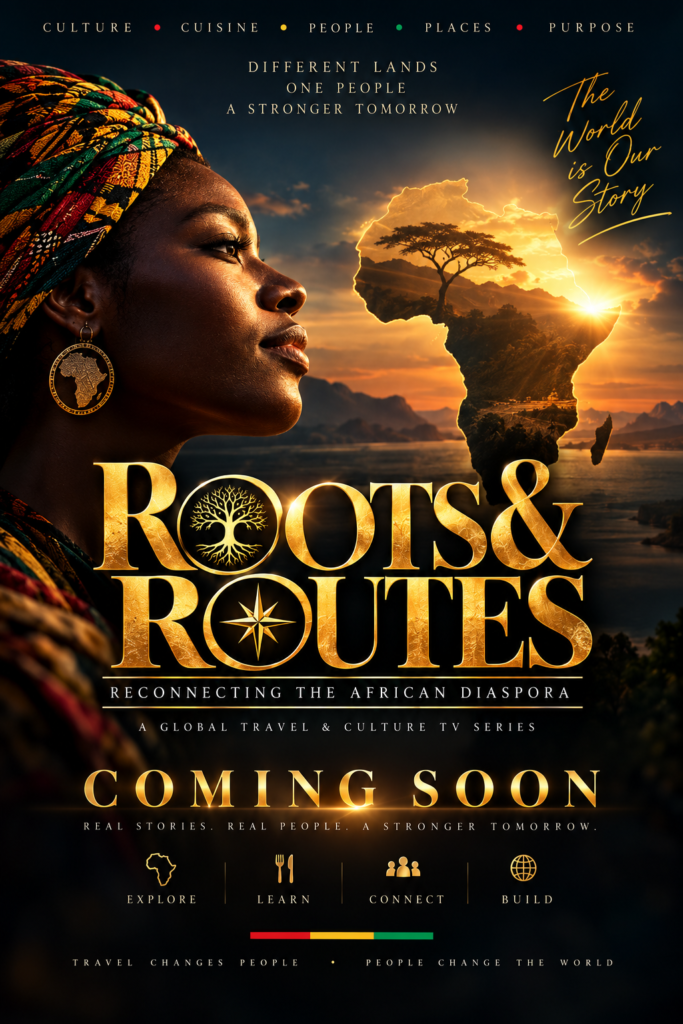
Roots & Routes: Reconnecting the African Diaspora
We were not lost. We were scattered. This show is the reunion.
| Format | Global travel docuseries, character led, unscripted |
| Season One | 8 episodes, 45 minutes each |
| Region | The Americas, with Africa set up in the finale |
| Segments | Culinary Adventures, Cultural Exploration, Reconnection Through Travel, The International Cookout |
| Languages | English with Spanish, Portuguese and French subtitles, and the reverse |
| Host | RJ Mood, Philadelphia native, based in Medellín |
| Status | In development, funding now |
Watch the Trailer
A minute in Medellín is where this story starts. Watch how a Philadelphia native found his own reflection halfway around the world, and why that moment is the whole reason Roots & Routes exists.
If this looks like your family, or a story you have never seen told this way, send it to them. That is how a series about a scattered diaspora gets made, one person passing it to the next.
We Were Not Lost. We Were Scattered.
Roots & Routes is a global travel docuseries in which RJ Mood, an American who moved to Medellín and found people who looked like him already there, travels to Afro-descendant communities across the Americas and Africa. In each city he cooks, listens, and learns a piece of a history that was scattered on purpose.
Then he does the only thing that makes sense at the end of a story like that. He brings everyone he met to one table.
Most travel television treats Black communities as scenery. This show treats them as family, and the address is inward. It is Black culture speaking to Black people, not explaining itself to anybody. Everyone is welcome at the table. Nobody has to translate themselves to sit at it.
What Happens in Every Episode
Every episode runs 45 minutes and moves through four recurring segments.
Culinary Adventures
Food as the entry point to heritage. Jollof rice, jerk chicken, Afro-Colombian viche, and the people who keep those traditions alive.
Cultural Exploration
Music, dance, history, spirituality and festivals, from the people who carry them.
Reconnection Through Travel
Where modern adventure meets ancestral experience, and where RJ stops being a visitor.
The International Cookout
The signature close. Everyone RJ met that week, at one table, eating. Unity you can see rather than a lesson you sit through.
Every episode opens with a personal question and ends in connection, not a lecture. Watchable in any order, better in sequence.
Season One: Eight Cities Across the Americas
Season One stays in the Americas on purpose. These communities are connected by the same trade routes, so the season holds together as one story, and the finale points at Africa.
| # | Where | Why It Matters |
|---|---|---|
| 1 | Medellín and Comuna 13, Colombia | The pilot. A Black region in a country nobody associates with Blackness |
| 2 | Cartagena and San Basilio de Palenque, Colombia | The first free Black town in the Americas |
| 3 | Salvador, Bahia, Brazil | One of the largest African-descended populations anywhere outside Africa |
| 4 | Loiza, Puerto Rico | Bomba, and Blackness inside the American passport |
| 5 | The Low Country, South Carolina and Georgia | Gullah Geechee. The language that survived |
| 6 | New Orleans, United States | The one American city where it was never fully severed |
| 7 | Portland and Kingston, Jamaica | Maroons, and the people who never surrendered |
| 8 | The Garifuna Coast, Belize and Honduras | A people who were never enslaved, and the finale that points at Africa |
Season Two goes to the continent.
Meet Your Host, RJ Mood
RJ Mood is a Philadelphia native who left America for Colombia and found a version of himself waiting there. He is a traveler, a bridge builder, and a Black expat who found freedom abroad and decided the story was bigger than his own.
His arc runs from celebrating Kwanzaa in Philadelphia to a journey through Colombia that changed how he understood his own history. He hosts as a participant rather than a narrator, which is why people open up to him on camera. He has spent years building travel communities that take Black travelers into the places this series films.
Why This Series, Why Now
The African diaspora is vast, resilient and deeply connected, and it was fragmented by displacement and erasure. Roots & Routes pulls those threads back together on screen.
For viewers, it is the chance to see yourself reflected across the globe, in places school never told you about. For the moment we are living in, it is an argument that heritage and community cross every border drawn to separate them.
The tone is warm, immersive and honest. Joyful, reflective, celebratory, and unafraid of the hard parts. Close-ups for intimacy, wide shots for the land, handheld energy so it stays real.
Back the Series on Kickstarter
Roots & Routes is independently funded, which is the only reason it can be made the way it should be: with local crews, real community access, and nobody editing the story into something safer.
Backing the campaign puts the pilot on screen. Here is what your support pays for.
- Local crews in every city. Fixers, local producers and camera operators who know the neighborhoods and hold the relationships. Access an outside unit cannot buy.
- Paying the communities we film in. A real budget line, not an afterthought. We do not extract stories for free.
- The International Cookout. Food, venue and the gathering itself in every city. The smallest line on the budget and the biggest thing on the screen.
- Post that honors the work. Edit, color, sound, music licensing, and subtitles in Spanish, Portuguese and French, because the diaspora does not watch in one language.
Every pledge, at any level, moves this from a pitch deck to a premiere. And every pledge makes the next conversation with a network easier, because a funded audience is the clearest proof a show has one.
Share the Trailer
If you cannot back it, share it. That is not a consolation prize, it is the actual ask.
This series is about a family scattered across oceans, and it will get made the same way it is being told: by people passing it along. A share from Philadelphia reaches someone in London. A repost from Accra reaches someone in Bahia. That is the show working before it has even aired.
Three things that help most, in order
- Send the trailer directly to one person who needs to see it. One text beats ten public posts.
- Post it with what it made you think about. Your words travel further than our caption.
- Tag someone whose family history you have talked about, and use #RootsAndRoutes so we can find you.
WhatsApp matters more than it looks. It is how the diaspora actually talks to itself across borders.
For Networks, Studios and Sponsors
Roots & Routes is built to travel. Anthony Bourdain: Parts Unknown meets High on the Hog, with a laser focus on the African diaspora, delivered 4K UHD HDR in four languages.
Why the format works commercially
- One travelling core unit of six, local crew hired in every city. The Parts Unknown model. It is why a show at this scale is affordable, and why the access is better than a flown-in unit can buy.
- Self-contained episodes with a season-long emotional arc. Watchable in any order, better in sequence, which suits both linear and streaming.
- Roughly 10 to 12 months from development through delivery of eight episodes, shooting in three geographic blocks with post overlapping production.
- A host who arrives with an audience. RJ Mood reaches a following across YouTube, Instagram, TikTok and Facebook that skews 35 to 44 and concentrates in the United States, Colombia and Canada.
The audience already exists. Industry estimates put the Black US leisure travel market at roughly $145 billion in 2023, and comparable travel and life-abroad series have historically drawn between 1.1 and 1.5 million live-plus-same-day viewers an episode. The core audience here is behavioral, not passive: people who are actively researching a move abroad, who over-index on completion and rewatch.
Partnership and press inquiries: contact us through the MOOD Travel Abroad contact page.
Frequently Asked Questions
Roots & Routes: Reconnecting the African Diaspora is a global travel docuseries hosted by RJ Mood. Each 45-minute episode travels to an Afro-descendant community and uses food, music and cultural tradition as the way into a shared history, ending with a gathering called The International Cookout.
RJ Mood is the host and creator, a Philadelphia native who moved to Medellín, Colombia and built his work around African diaspora travel and cultural immersion. He hosts as a participant rather than a narrator, which is why the conversations on screen feel like conversations rather than interviews.
Eight cities across the Americas: Medellín and Comuna 13 in Colombia, Cartagena and San Basilio de Palenque, Salvador de Bahia in Brazil, Loiza in Puerto Rico, the Gullah Geechee Low Country, New Orleans, Portland and Kingston in Jamaica, and the Garifuna coast of Belize and Honduras. Season Two goes to Africa.
It is the closing segment of every episode. RJ brings together everyone he met that week, local chefs, musicians, elders and neighbors, around one table for food and music. It is the show's argument made visible: the diaspora is one family with many kitchens.
Back the campaign on Kickstarter at any level, and share the trailer. Pledges fund the crews, the community payments and the post-production. Shares prove the audience exists, which is what turns a funded pilot into a full series order.
The address is inward. This is Black culture speaking to Black people rather than explaining itself to anyone. That is exactly why it travels: the food-and-place audience that made Parts Unknown and Somebody Feed Phil work comes for the plate and stays for the person cooking it.
Not yet. Roots & Routes is in development and independently funded while we are in conversation about distribution. Backing the campaign and sharing the trailer directly strengthens those conversations.
It means the global community of people of African descent, scattered by the transatlantic slave trade and by migration since, who carry connected traditions in food, music, language and faith. The show follows those connections between places rather than treating each one as isolated.